Our story begins with the legendary British prog rock band King Crimson. Two of their founding members were bassist Greg Lake and lyricist Peter Sinfield. They were in the band together for two albums before Greg left, then Peter stayed for two more albums before he left. But immediately after Greg left, he formed another band with a keyboardist named Keith Emerson and a drummer named Carl Palmer. That band was very creatively named Emerson, Lake & Palmer.
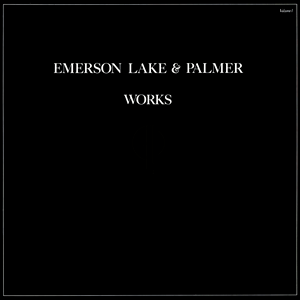
After a world tour in support of their 1973 album Brain Salad Surgery, Emerson, Lake & Palmer took a long break. They reconvened in 1976 to record a new album, and in March 1977, they released the double LP Works Volume 1. They co-produced the album with Peter Sinfield. It was, by a wide margin, the band’s longest studio album at an hour and 27 minutes. The way it was structured was that three of the four sides were each devoted to an individual band member while the fourth and final side was for all three members together. The album’s first single, “Fanfare For The Common Man,” was from the fourth side and became a hit in the U.K. and Australia. The second single, “C’est La Vie,” was from Greg Lake’s portion and received a moderate amount of rock airplay in the U.S.
On paper, that makes a lot of sense. You see, Works Volume 1 is heavily influenced by classical music. Emerson studied classical music as a child, which led to him incorporating classical music into his prog rock material. His side of the album is a single 18-minute piano concerto. Palmer also had classical music training, so his side of the album featured renditions of Bach and Prokofiev. “Fanfare For The Common Man” was adapted from a 1942 piece of the same name by Aaron Copland, whose work the band had already adapted on a previous album. However, Greg Lake had more straightforward rock tastes. So the Brits liked the song that sounded like classical music while the Americans liked the rock song.
Why the Australians also liked “Fanfare For The Common Man,” I couldn’t say. Believe it or not, the whole album sold very well in Australia. Looking into it, I discovered that the biggest hit of 1977 in Australia was “Don’t Cry For Me Argentina,” as performed by Julie Covington on the original Evita concept album. Maybe after Gough Whitlam was removed from office, Australians wanted to appear more sophisticated to the Brits. I can only speculate.
But back to Works Volume 1, listening to the album in order is quite the experience. You listen to Emerson’s 18-minute piano concerto, flip the vinyl over to Side B, and immediately hear Greg Lake singing folk rock that often sounds like Jethro Tull. “Food For Your Soul” on Carl Palmer’s side is a loud and busy jazz rock instrumental that reminds me a little of early Chicago, maybe with hints of Frank Zappa as well.
Suffice to say, well-made though it is, Works Volume 1 probably won’t be to everybody’s taste.


Leave a Reply